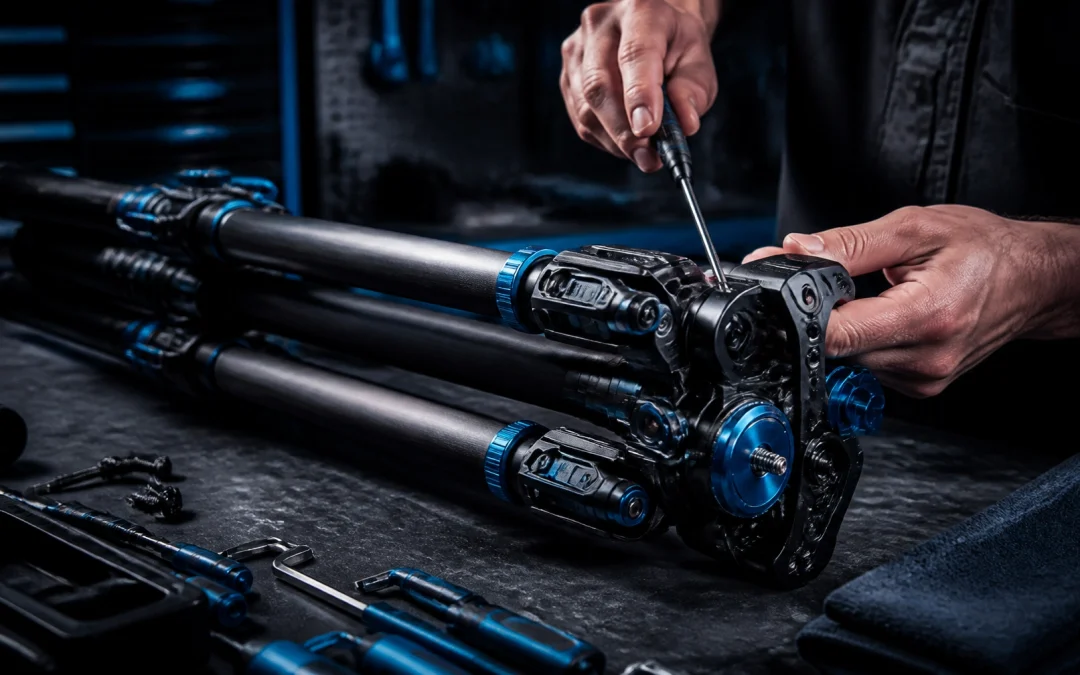
At TripodRepair, we encounter professional photographers, videographers, and studio managers daily who face a critical equipment dilemma. Your primary tripod: the reliable foundation of countless sharp landscape captures or smooth cinematic pans: has sustained damage. Perhaps a leg lock is slipping, a center column is jammed, or a heavy impact has left carbon fiber splintered. Immediately, a familiar question arises: Is this precision tool worth restoring, or has it reached the end of its operational lifespan?
Making an informed salvage versus replacement decision requires more than guesswork. It demands a meticulous evaluation of structural integrity, replacement parts availability, financial thresholds, and long-term reliability. In this comprehensive guide, we examine the quantitative and qualitative factors that define when a tripod can be expertly salvaged and when it is truly time to invest in new gear.
Understanding Damage Severity

Distinguishing between minor wear and catastrophic structural failure is the cornerstone of professional equipment maintenance. Not all damage carries the same weight, and misjudging the nature of a defect can lead to catastrophic camera drops in the field.
Surface versus Structure
Cosmetic scuffs, minor paint wear, and sticky rubber grips rarely threaten equipment safety. However, structural failures: such as cracked magnesium casting spiders, bent aluminum leg sections, or delaminated carbon fiber: compromise load-bearing capacity immediately. When evaluating your equipment, identify whether the compromised part is a replaceable modular component or a core structural element. Modular failures are almost always prime candidates for expert repair, whereas severe structural deformation often signals that retirement is near.
Mechanics and Stability
A tripod is only as stable as its weakest joint. Loose leg angles, creeping center columns, and stripped tension knobs degrade shooting precision. Fortunately, many of these mechanical issues stem from worn-out internal gaskets, sheared pins, or misaligned collars. Through meticulous servicing and precise component replacement, these mechanical maladies can be entirely reversed, restoring factory-tight performance without the expense of a full system replacement.
The 50% Rule
Navigating the economics of equipment maintenance requires a clear financial framework. In the professional repair industry, technicians rely on standard cost thresholds to guide clients toward optimal financial decisions.
Financial Thresholds
The golden rule of equipment salvage is straightforward: if the total cost of repair (parts plus specialized labor) exceeds 50% of the price of an equivalent new tripod, replacement typically becomes the more sensible financial route. For entry-level or mid-range aluminum tripods, a complex leg assembly replacement can easily approach or surpass this 50% threshold. Conversely, premium professional systems: such as high-end Gitzo, Manfrotto, or Sachtler platforms: command a significantly higher replacement value, making extensive repairs economically viable up to 60% of replacement cost.
Calculating ROI
Consider your initial investment and expected remaining lifespan. If a high-end professional tripod requires a $150 overhaul but would cost $800 to replace outright, professional restoration yields an exceptional return on investment. On the other hand, pouring capital into an aging, entry-level tripod that suffers from multiple systemic wear points represents false economy.
Parts and Availability

The feasibility of any repair project is fundamentally tethered to parts availability. Navigating manufacturer catalogs and aftermarket components dictates whether a restoration takes days or proves entirely impossible.
Sourcing Components
Major professional brands maintain robust inventories of replacement parts, allowing specialized technicians to source exact-match leg locks, geareddrive shafts, and tension collars. When dealing with discontinued or vintage models, however, sourcing proprietary parts becomes significantly more challenging. Expert repair shops maintain extensive salvage inventories and custom fabrication capabilities to bridge this gap, ensuring even legacy gear can often be brought back to life.
Brand Ecosystems
Investing in modular professional equipment pays dividends when repairs become necessary. Brands that design their tripods with easily swappable legs, removable center columns, and standardized head mounts empower technicians to replace only the damaged sub-assembly rather than condemning the entire unit. For more insights on brand-specific maintenance, explore our guide on Gitzo vs Manfrotto vs Sachtler tripod repair.
Professional Restoration Benefits

Opting for professional restoration offers distinct advantages over DIY fixes or immediate disposal, safeguarding both your budget and your creative workflow.
Craftsmanship Matters
Tripod mechanics demand exact tolerances. Improperly aligned leg pivots or incorrectly torqued carbon fiber collars can introduce micro-vibrations that ruin long exposures and sharp telephoto shots. Our specialists utilize professional torque specifications and alignment jigs to ensure optical-grade stability. Whether you are dealing with sticky fluid movements or loose panning mechanisms, our tripod head repair services guarantee optimal damping and smooth articulation.
Sustainability Impact
Choosing repair over replacement directly reduces electronic and industrial waste. High-end tripods represent significant embodied energy in aluminum smelting, carbon fiber weaving, and precision machining. By restoring your trusted gear, you extend its operational lifespan, minimize environmental footprint, and preserve the tactile familiarity of equipment you already trust in the field.
Salvage Versus Replace
When structural damage renders a full tripod repair economically unfeasible, all is not lost. Strategic salvage allows you to recover residual value and optimize your kit.
Salvage Components
If the tripod legs are severely compromised by a crushing impact or extreme fatigue, inspect the remaining components. High-end ball heads, fluid video heads, Arca-Swiss quick-release plates, and counterweight hooks can often be completely salvaged. These modular components frequently retain 70% or more of their original utility and can be mounted onto brand-new leg sets ("sticks"), saving you from purchasing an entirely new bundle.
Strategic Upgrades
Use irreparable damage as an opportunity to upgrade your workflow. If your older aluminum tripod legs are worn out, salvage your premium fluid head and pair it with modern carbon fiber legs, achieving a lighter, stiffer support system tailored to your current production demands.
Restore Your Gear

Deciding between salvage and replacement does not have to be a guessing game. When your valuable support equipment suffers damage, let our expert team provide an honest, transparent evaluation of your gear's repairability.
At TripodRepair, we combine deep mechanical expertise with meticulous craftsmanship to restore your equipment to peak performance. Do not let a damaged leg lock or sticky head compromise your next production. Contact our team today to request an evaluation, and let us help you regain absolute confidence behind the lens so you can capture every moment with uncompromised stability.